It's Beginning to Look A Lot Like Fun*Run Time

It's ALREADY that time of year again: The ADAPT Fun*Run for Disability Rights is April 22nd 2012. Maryland's fundraising goal is $8,000 this year. Yes, that's right, $8,000

Donate $1! Donate $10! Donate $100! Donate $1,000! JUST DONATE so we can FREE OUR PEOPLE! http://adaptfunrun.org/runner.php?id=7 I thank you very much for your support!
Showing posts with label disability awareness. Show all posts

Thursday, October 13, 2011

I Made a Difference (A Disability Awareness Month Post)

Yesterday afternoon I was somehow drawn to point my web browser here. I don't know why I would do something so torturous to myself but I did. If you go way down on the page it says


[the powerpoint slide, right, says "Disability & The Human Service Worker October 24th 2007"
The department collaborates with community agencies to sponsor workshops and professional and family education. Annual events include a Disability Awareness Workshop [emphasis mine] a Supervisor Training Workshop, and a workshop in partnership with The Leukemia and Lymphoma Society on relevant issues for families living with childhood cancer.
So of course I was drawn to click on the link below that, which leads to a page that has a whole blurb on the workshop:
Disability Awareness Workshop

This workshop is held each October [for national disability awareness month] and is designed to raise student awareness and understanding of individuals with disabilities. In addition, participants are informed about available resources and potential careers. In 2010, over 180 undergraduate students, faculty and community professionals attended. The 2011 Workshop will be held on Wednesday, October 26. This year's featured speaker is Alison Malmon, founder and executive director of Active Minds. This nonprofit organization develops and supports student-run chapters at colleges and universities in order to educate students and raise awareness of mental-health issues.
If you click on the tags "independent study" and "workshop planning" below, you'll note that this workshop was my baby. I initiated it a week before Thanksgiving 2006. It took until March until I found out I was approved to do it. I waited four long agonizing months, and then spent 7 more agonizing months planning it. It was arguably the most difficult thing I've ever done in my life. I spent most of those 7 months running around like a chicken with its head cut off. But it was worth it. It was phenomenal.

[The 2007 student panel. Please don't ask me why there are no men there. ARGH!]

This is something I wanted to work and be so successful that it would continue, and clearly it has. On the feedback sheets I got comments such as:
"I feel this seminar has changes my outlook on my field in family studies"

"it is critical that the public be made more aware of workshops like this one. I would suggest that professionals spread the word in some way perhaps and evening at a religious institution (church, synagogue, etc.), a fraternal organizations, etc."

"very nice idea! I really enjoyed myself! Even if you are not going to be working with people with disabilities it is beneficial to be informed about society and life"

Looking at MY WORKSHOP (for it will always be my workshop) placed so prominently on the department's website makes me feel good, of course, but it also makes me feel horrible. It makes me feel horrible because I have done nothing with my life since then. My life is one giant pit of nothingness. A person who can change the world like that, that person should...


I stopped myself from finishing that sentence. It won'tever do me any good to finish it. Instead of dwelling on what I should have accomplished since then, I thought about what I did accomplish. I singlehandedly, just by getting mad one day (that post gives a good breakdown the workshop) and deciding to fill a hole in the instruction of many students who will go on to become professionals working with disabled individuals, changed the lives of thousands of people.


2011 will be the 5th annual (!!!!!!!) Disability & The Human Service Worker workshop, and I imagine by the end of this month about 700 students and professionals will have attended the 3hr workshop at least once. If it still does what it's supposed to, if the workshop still brings a lifespan multidimensional view to disability, if it still focuses on peers in a way that a clear connection is made between disability and the audience's (majority 18-23 year olds) life; if people still learn that disability is not a tragedy, that it is many things, least of which is a diagnosis; if people still learn to look at the individual first and what that individual can offer, instead of the narrow view of disability many had before, imagine what kind of impact that can have.
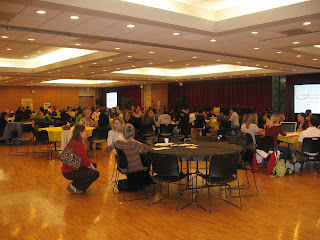

[right, a crowd shot of the 2007 workshop]


Whether or not you chose to work in a clear cut disability related job, disability is everywhere. Imagine just how many clients each of those individuals will come in contact with over the 40 years they will be working, and how differently they will interact with those clients and their families. The positive impact of a three hour workshop won't last for all 700 people, I'm not delusional (It clearly didn't make much or any of an impact for some that were already professionals [and that's just one example of their horribleness, check out some more]) but even if it has made a lasting impact for just 100 people, look at what an impact I made on the world. Look at what an impact just 1 person can make on the world.


When I look back at myself at that time I do so with a large degree of detachment. I don't see me at all (although clearly I'm the one in the pony tail in that second picture), and I can't figure out what being possessed me. I don't see myself as someone who can execute small things, like hygiene and basic cleaning. Forget about changing the lives of thousands. Who me? NAH! You're delusional. Not me! But clearly I did -- it's right there on the website.


And if I did it once, I can do it again. Even if I am a few years rusty. It's not about what a person should have done, it's about what a person can do. And clearly I can do. Even though most of the time I think I can't. I need to remember what I did, and stop focusing on all I didn't.


"One person can make a difference. And everyone should try." ~JFK

Sunday, October 31, 2010

It's The End of Disability Awareness Month

Wendy On Wheels just looks GREAT! Anyone read it yet? Thanks AZ for posting!

Wednesday, October 20, 2010

CURE PITY!

I realized the other afternoon that it's October, disability awareness month, it's 2/3 over, and I've done nothing for it. We can't have that! So without further ado, here's a video from Gillette Children's Cure Pity campaign. There's a bit of subtle ableism in there, but I still think it's great.

Wednesday, July 7, 2010

Empowering PWDs Blogswarm

I just found out about this event from Glenda and have copied the info below. Yes, I will be writing. I know... what a shocker. I hope some of you join as well. Here, copied from a previous post, is my definition of what a blogswarm is:

A blogswarm is like a blog carnival on a larger scale, where as many as hundreds of bloggers (as opposed to 10s like in a carnival) commit to blogging on a certain topic on a certain day, usually in hopes of gaining mainstream media attention or just greater awareness and understanding of an important topics. Here is the Anti-telethon Blogswarm (Kara, please update one of your blogs), DUH City & of course the ever popular BADD 2009.
Hello Friend,

I just wanted to take a second and let you know about an upcoming BloggersUnite event, People First: Empowering People with Disabilities. It is taking place on July 24, 2010 and the goal of this event is to raise awareness about the challenges that face people with disabilities every day and how we can help eliminate these challenges.

By sharing stories of how you, a friend, a colleague, or maybe a family member have dealt with the challenges of living with a disability, we can raise awareness about this issue and bring down some of the barriers to equal accessibility and participation that exist today for people with disabilities.

If you don’t have a personal story to share, you can still help! Write about an organization that provides support to people with disabilities or that is helping to provide equal access. Let you readers know some facts about the number of people living with disabilities, the challenges they face, and how each of us can work towards creating a society that provides equal access to everyone regardless of our physical or mental abilities.

Whatever you choose to write about, we’d be thrilled to have you write a post as part of this event. Read more information about the event.

Thanks for reading and have a great day,

Jason Teitelman

Wednesday, March 3, 2010

Today is Spread the Word to End the Word Day

My post today is two videos that I feel say it better then I could


Tuesday, February 2, 2010

I Have Cerebral Palsy...


[image description: a green rectangle with the words I have cerebral palsy... cerebral does not have me, a green cerebral palsy awareness ribbon, and one of those green awareness bracelets. Did you know that green is also the awareness color for both organ donation and save Darfur.]

A few weeks ago I saw this clipart as the footer on someone's blog. I will not say who, as I do not want them to feel bad. Anyway, I've seen that ribbon icon on more than 1 blog. The ribbon has always made me feel uneasy, but this clipart even more so. It's those words, "I have cerebral palsy... cerebral palsy does not have me." I almost had a pit in my stomach when I saw this. You ever get that feeling and you just don't know why? Well I decided to think it over and to my surprise, it didn't take long to figure it out.

First there is that ribbon. What are ribbons associated with? If I polled 100 people I'm sure the top 2 answers would be AIDS and breast cancer. Following along would also be a whole long list of DISEASES (although somehow I don't mind ADAPT's orange ribbon [left]. I've fully embraced the orange). By associating CP with an awareness ribbon we are conceptualizing it w/in the context of the medical model, and I REFUSE TO BE MEDICALIZED. This is one reason why autism advocates detest that horrid puzzle ribbon. Even when I go for my semiannual botox appointments I cringe at the word patient. My doctor works in a hospital even. doctor + hospital = patient (did you know that it gets billed to insurance under a code for outpatient surgery. 7 injections do not equal surgery) I know that; but patient is up there on my list of most damaging words, along with inspiration, special, the r-word, and wheelchair bound. And those bracelets, when the first ones came out they were for testicular cancer. Ick.

Then there are those words, "I have cerebral palsy... cerebral palsy does not have me." Cerebral palsy DOES have me (so does bipolar) and that is something I take much pride in. It took me a very long time to get to this point where I am so comfortable with it, but I would not be who I am if I did not have disabilities and I DO NOT WANT MY IDENTITY MARGINALIZED. By saying this you are implying that I am supposed to push one of the biggest parts of me aside, and I just don't see how this can be done. There would be no Cheryl were it not for my diagnoses (there I go medicalizing). I know what the phrase is supposed to mean. See me as a person, interact with me as a person. I am not wheelchairs and orthotics, but these things are parts of me. I want you to see, interact with, embrace the sum total of my existence in it's entirety, and that does in fact include CP and BP. Don't push them aside, think of them as part of the package deal.

*off my soapbox*

Thursday, December 17, 2009

The Braidel

I know Chanukah's like almost over, but I just had to post about the Braidel. If it wasn't already too late to ask for presents I'd ask for one of these.


A dreidel for the blind spins a new, year-round lesson

LAKE OSWEGO, ORE. — For centuries of Hanukkah celebrations, the dreidel has served as both children's toy and religious symbol, marked with Hebrew letters that stand for “a great miracle happened there.”

Artist and Jewish scholar Marsha Plafkin Hurwitz's version of the four-sided top is more than child's play. It's also a conceptual sculpture, disability aid and sensitivity training tool.

She fashioned a metal dreidel featuring raised Braille bumps several years ago. First marketed as modern Judaica, “The Braidel (The Braille Dreidel)” joined the collections of the National Museum of American Jewish History and the Jewish Museum of London. Now it's finding fans among disability-rights advocates.
Hurwitz, a graduate of New York's Jewish Theological Seminary, is now spinning it off as a classroom game for all ages, with input from Portland State University's Project Braille program.

“It's taken on a life of its own,” Hurwitz said, leafing through a prototype of The Braidel Game manual at the kitchen table of her suburban home south of Portland, Ore. “This is something for Jews, Christians, Muslims, anyone who wants to engage how their tradition has treated disability.”

By making a tradition from the Jewish festival of lights accessible to the visually impaired, Hurwitz has set a much-needed example for the entire community, said Becca Hornstein, executive director of the Arizona-based Council for Jews With Special Needs, who shared the Braidel with the Jewish Special Educators International Consortium earlier this year.

“We're an old, old religion, but only in the last 25 to 30 years has there been a civil rights movement for people with disabilities,” she said. “Before that, people with certain disabilities were cared for but not really integrated into a lot of Jewish life. Bravo to Marsha for taking a common, everyday item in Jewish life and modifying it so that a person with a visual impairment can play it without thinking about it, without feeling singled out.”

Hurwitz took some artistic license with her design: the Braidel has a rounded base, rather than a dreidel's traditional sharp point , to prevent it from creating a safety hazard for blind or blindfolded players. She says she borrowed an abbreviation used on Israeli dreidels for “a great miracle happened here” to show players that miracles can be personal, everyday experiences, not just distant events to occasionally commemorate.
Sales have increased leading up to Hanukkah, which begins this year at sunset Dec. 11, but Hurwitz said she designed the Braidel for year-round use, both within the Jewish community and beyond.

Sold through Hurwitz's Web site, Art as Responsa (www.art-responsa.com), the Braidel costs $24; the game, which comes with blindfolds and playing chips, runs from $75 for four players to $375 for a classroom set. Eighteen percent of proceeds are donated to Helen Keller International.

Also, here's a great Chanukah flash mob:


Thursday, December 3, 2009

I Almost Forgot Today Is UN's International Day of People with Disabilities

[image description: the UN symbol. It says UNITED NATIONS enable]

I haven't seen any posts. Well, scratch that. One. I feel like it's my duty to write about the Convention on the Rights of PWDs, but I forgot the USNUSP teleconference so I know nothing about it. Turns out though I was thinking of writing a post on Susan Boyle--I live in the USA, she lives in Scotland, loose way to make a connection, I know, but any commemoration is better then none. The original title of the post was going to be "Susan Boyle, I Want Your Memoir." I'm sure it's in the works, and I'll be one of the 1st to preorder.

I was thinking about how I heard she had the most sales of any female artist EVER on a release date. Media making the point that you don't have to look like Brittney apparently. No one is snickering now. I was listening to clips on iTunes and I won't be buying the album. If it was just show tunes or something I would, LOVE her voice, but it's a weird mix, some songs are odd for her I think. I will however be buying 2 songs-- 1) I Dreamed a Dream. As much as I hate to say it, I find it inspirational. Maybe not the words as much as the title and the connection. The second is You'll See because she's said that's her inspiration.

You'll See is her dig at all the people who used to beat her up as a kid and verbally abused her because she has at least 1 LD and she was different. That's what I was thinking about. I was thinking about how she has an opportunity to do so much good in the world. To turn that around. Not that 12 year old nasty kids are going to read her memoir, but if enough teachers do and enough teachers feel empathy (NOT sympathy) and begin to teach character, things will slowly turn around. Susan has the ability to be a catalyst for so much change all over the world now that she is an international superstar. She seems comfortable enough talking about her past and I hope that continues.

So this is my contribution to International Day of PWDs. If you know of any others out in the blogsphere, please comment and point me in that dirrection. Leave a link. Thanks!

Monday, March 23, 2009

HB281 is now SB907

The bill I submitted written testimony for has passed the house and is now being heard in the senate tomorrow afternoon. I will be schlepping to Annapolis to testify in person this time because it is on a better day of the week. This will be my first time taking paratransit somewhere that far. It could be interesting... If you care at all, my revamped testimony is below, and if you live in Maryland, find your state senator, contact them and tell them to pass it.

------------------------------------------------

My name is Cheryl *censored*. I am a senior Family Studies and Community Development Major at Towson University and am looking forward to spending my life mentoring children with disabilities after graduation. I am here today in strong support of SB907.

I have been involved in disability rights/awareness for the past 9 years. I started speaking to groups when I was just 15 years old, through a program run out of Montgomery County Public Schools, Montgomery Exceptional Leaders. After high school I continued seeking out speaking opportunities on my own. I have spoken to children as young as 9, and have done several professional training workshops.

I have chosen to work with children with disabilities because I've witnessed first hand the high comorbidity rate between having a visible disability and depression. It breaks my heart to hear teens and peers talk about feeling worthless just because they can't drive or have some scars from surgery. It doesn't have to be this way, people don't have to focus just on what they consider to be their negative aspects, although isn't that human nature? Doesn't EVERYONE?

SB907's emphasis on educating K-12 students will help ALL students, not just students with disabilities, because the curriculum will help students to learn that there are many factors that make people who they are. It will also help to foster a sense of pride in students with disabilities by introducing them to famous people who are just like them—something I wish someone had done for me when I was a kid.

I was also pleasantly surprised to learn that SB907 places a significant emphasis on post-secondary education, something I have focused on in recent years. Family studies majors graduate prepared to work in a variety of human services jobs. Many of my fellow graduates will end up working front lines with children and/or families touched by disabilities, and after interacting with them and hearing a free association with the word disability, I was more then frightened by my vision of them interacting with disabled clients in the field. I knew my department wasn’t doing a good job preparing graduates to work with this population so I took it upon myself to undertake a very long and overwhelming independent study. For about a year, I poured my heart and soul into creating a three hour disability awareness workshop for 120 Towson University students enrolled in various Family Studies classes.

Preliminary data from that initial workshop shows overwhelmingly how well it worked. Students responded that they learned things such as disability etiquette, the impact of disability on the individual and family, and the need to view each person as an individual, among other things. The workshop was viewed by the Family Studies Department and other associated Towson University departments (Disability Support and Towson University Outreach) as such a success that it is offered as an independent study to a senior Family Studies student annually. The Oct 2010 workshop will be the 3rd annual. It is my greatest wish that disability will start to become included within lectures covering cultural competency and that something along the lines of my workshop can be replicated on all of the campuses across the state and attended by every student in a human services major.

Please support SB907. Your support means a lot to everyone that is, has been, or will be touched by disability in their lifetime.

Tuesday, February 24, 2009

My Testimony in Favor of HB281


[image description: the disabled & proud logo--black rectangle, purple boarder, white writing]

I mentioned in a previous post that I found out that a bill was being introduced into the Maryland Legislature in favor of Disability Rights/History education in schools. I wish I could have done a bit more for this, and I wish I could have skipped class and gone to testify in person, but I did the best I could, and in fact, I think I went overboard... Can someone tell me how to rein in the passion?

--------------------------------------------------------------------

Testimony in SUPPORT HB 281

Health and Governmental Operations

And

Ways and Means Committees

February 25, 2009

By Cheryl *censored*

My name is Cheryl *censored*. I am a senior Family Studies Major at Towson University. I am writing this in strong support of HB281 and am saddened that my class schedule does not permit me to testify in person.

I support HB281 for 2 reasons. The first and most important reason is the bill’s emphasis on educating K-12 students and the pride and understanding that will instill in our youth. The second reason is because I was very excited to read that the state’s public colleges and universities were included in the bill as well.

For about a year, I poured my heart and soul into creating a three hour disability awareness workshop for 120 Towson University students enrolled in various Family Studies classes. This was preceded by a discussion wherein my “peers” without disabilities were asked what first came into their mind when they heard the word disability. Their answers were some of the most ableist—prejudice in favor of able-bodied—remarks I have ever heard. They were “the elderly, people who cannot work, people in wheelchairs, and young children.” I only fit into one of those categories and that’s only sometimes. I don’t always use my wheelchair. Sometimes I walk, or waddle as I prefer to describe the way I walk.

Family studies majors graduate prepared to work in a variety of human services jobs. Many of my fellow graduates will end up working front lines with children and/or families touched by disabilities, and to say I was frightened by my vision of that would be an understatement. I knew my department wasn’t doing a good job preparing graduates to work with this population so I took it upon myself to undertake a very long and overwhelming independent study.

Preliminary data from that initial workshop shows overwhelmingly how well it worked. Students responded that they learned things such as disability etiquette, the impact of disability on the individual and family, and the need to view each person as an individual, among other things. The workshop was viewed by the Family Studies Department and other associated Towson University departments (Disability Support and Towson University Outreach) as such a success that it is offered as an independent study to a senior Family Studies student annually. The Oct 2010 workshop will be the 3rd annual. It is my greatest wish that something such as this can be replicated on all of the campuses across the state and attended by every student in a human services major.

My Evolving Disability Pride and Empowerment

As you see below, I have wondered who my peers are since I was a child. All people identify with people who are most like them. Now that I’m an adult, am about to graduate from college, and am involved in the disability rights movement I am finally able to dual identify. I tell people I am bi-cultural. I have friends and peers who are struggling through my Senior Seminar class with me, as well as other academic experiences, but who may or may not have a disability. I also have friends and peers who have spent time in Rosewood or various nursing facilities, who are activists here today for Developmental Disabilities Day, and whom you may think are nothing like me but are often more like me than anyone else. I am comfortable being me and I ache for others who are not yet that comfortable being different.

What Disability Awareness Month Means to Children

I was born premature which resulted in a diagnosis of spastic triplegia cerebral palsy (CP) and in 2007 I was diagnosed with bipolar II disorder. When I was growing up I went to hours and hours of physical, occupational, and speech therapy, as well as therapeutic horseback riding, and at times swim therapy and massage therapy. I couldn’t walk independently until I was 4 and then I had 7 surgeries between ages 5 and 19 which required more hours of therapy and adaptive equipment such as orthotics, wheelchairs, crutches, and walkers, and time away from school and peers.

PEERS Who are my peers? Who were my peers? I wish I knew…

Although my CP related motor skills issues and my later psychological issues impacted my school performance greatly, my disabilities have not impacted my intellectual capabilities at all. I was mainstreamed starting in kindergarten and enrolled in Advanced Placement classes in high school. I’m planning on pursuing multiple masters degrees, and maybe a PhD. I was never in school with other kids with significant disabilities. I was the only kid with a physical disability in my elementary school and later was the most disabled person to ever be in honors/AP classes in my high school. Everyone else in my high school with a physical disability was in special ed.

While this was academically appropriate, it turned out to be far from ideal. It fed me a very detrimental message. My “peers” were all non-disabled kids. As young as 7 I began to become ashamed of my disability and wanted to hide it from them. I didn’t want to be seen in public in my wheelchair, or worse, near anyone else I knew who used one. To me, having a disability automatically meant that you’re intellectually disabled. I knew I wasn’t like my “peers” because they didn’t go to therapy 3 days a week after school and I didn’t go to ballet or swim team like my best friends. I also knew I wasn’t like the kids I knew in special ed. So I was peer-less and in limbo most of my life, not wanting to identify as a person with a disability, but not able to fake my way into passing as a person without a disability.

My understanding of Black History and Hispanic History months (I am neither African American nor Hispanic) and the emphasis on teaching about great African American and Hispanic leaders is to instill a sense of pride in young African American and Hispanic students and to give them role models to aspire to. For other students, teaching about famous minority leaders helps present a more well-rounded picture of history. For both groups of students, teaching about minority leaders helps to dispel racist beliefs that we all hold.

Well what about famous disabled leaders? People with disabilities identify as a distinct minority culture as well. We have our own literature, idioms, and customs. We also have our own prejudice, ableism. With 18% of the country being classified as having a disability we represent a larger segment of the population than African American or Hispanics. Our culture encompasses these groups as well. Disability knows no ethnic, racial, or economic boundary.

So why don’t we teach disability rights history in schools? It seems more then obvious to me. I know who Martin Luther King Jr, Rosa Parks, and Frieda Kalo are. I’m sure you do too. I also know who Ed Roberts and Diane Coleman are. Do you? Ed Roberts was one of the founders of the disability rights movement. He obtained a degree from UC Berkley, started the independent living movement, and in the 1970s led a month long protest to get the terms of the rehabilitation act instated. He was on an iron lung. Diane Coleman works for a large independent living center and founded a very large, very well known, and very successful national disability rights organization. She’s a lawyer and she’s also in a wheelchair. What about Michael Phelps even? Everyone knows who he is, but do you also know he has ADHD? Here are 3 examples of successful people with significant disabilities. There are many more.

When I was 15 I was suicidal because I was despondent over being different. I know of other people as well. I didn’t have a MLK or Frieda Kalo to look up to. I didn’t hear about Ed Roberts or Diane Coleman until college. Recently I began to explain Ed Roberts and the independent living movement to my mom who was flabbergasted that she was an adult while all of this was going on and this was the first she had ever heard of him. MLK and Rosa Parks are household names. Maybe if Ed Roberts was a household name I wouldn’t have felt so marginalized from my “peers.”

I thank you from the bottom of my heart for your support of HB281 and the empowerment of the citizens of Maryland--the empowerment of youth with disabilities, the empowerment of families with disabilities, and the empowerment of students and professionals who work with people with disabilities.

Wednesday, February 11, 2009

Able to Choose

Over at Pipecleaner Dreams Deborah has a post about a new campaign in Virginia, Able to Choose. The campaign's aim is to increase community inclusion for people with disabilities. Whoever came up with this thing, RIGHT ON! WAY TO GO! I APPLAUD YOU! A standing ovation in fact. I'm just wondering how people feel about the way it is being run? Generally I am adamantly against simulations (link leads to an article) but in this case somehow I am all for it. Why? I think because it's not a disability simulation. It is a simulation about program models. They're not trying to create sympathy but rather empathy to lead to change (did I interpret that right?) Comments?

Wednesday, February 4, 2009

I GIVE UP!!!!!

[image description: woman sitting in front of a computer about to tear her hair out]

I have to do this assignment for Senior Seminar in Family Studies based around one of the family life education content areas. I was assigned family life and public policy and am trying to design a research paper and 75 minute presentation around what I decided to term Nothing About Us Without Us: How to Empower Your Clientele. I am shaping the whole presentation around Bob Kafka's Pitchfork Approach to Social Change. [see picture left. It's a hand, but same deal]

It could turn out really cool. But could and trying are the words of the day. I could scream right now if I wasn't right in the middle of the library. There's just this one big hitch--this 8-10pg research paper that has to go with it. We have to have 4 articles from peer reviewed journal articles that support our topic of choice. Fine. Not a problem. What is a problem is that they have to be actual research studies done on our topic. Not literature reviews, not conference papers, and certainly not newspaper articles/ADAPT press releases. Well let me correct myself a bit. We can have those things included as long as they're secondary to the damn research articles that I can't find. I've sat here for 3hrs searching databases. I can find things that have been published in peer reviewed scholarly journals but not research studies.

My professor did find me an article that has to do with Olmstead. It was written by some very cool people. Carol Gill from University of Illinois at Chicago and Diane Coleman of Not Dead Yet, among others. Someone from Access Living is even listed as an author. Anyone from Chicago is A OK in my book. Chicago seems to be the Mecca of disability rights. The problem, I gave up with the community organizing thing and went to Olmstead instead and couldn't find anything else to use either. I can't go off of the reference list from the article I have because most of their articles are Chicago Tribune articles. Can't use those...

I could do a really cool awesome fantastical presentation if only I could FIND SOMETHING!!!!! So I give up. I surrender. I am officially done for the day.

On another note a bill addressing disability awareness in educational settings (all public elementary, secondary, and post-secondary institutions) has been introduced into the Maryland legislature. The Maryland Disability Law Center has decided to support it of course and I have personally been asked to be the lead point person on all efforts surrounding this bill, even though I don't work for them. Stressful, but AWESOME!

Blog Widget by LinkWithin

Blogiversary

Get your own free Blogoversary button!
 
design by suckmylolly.com